
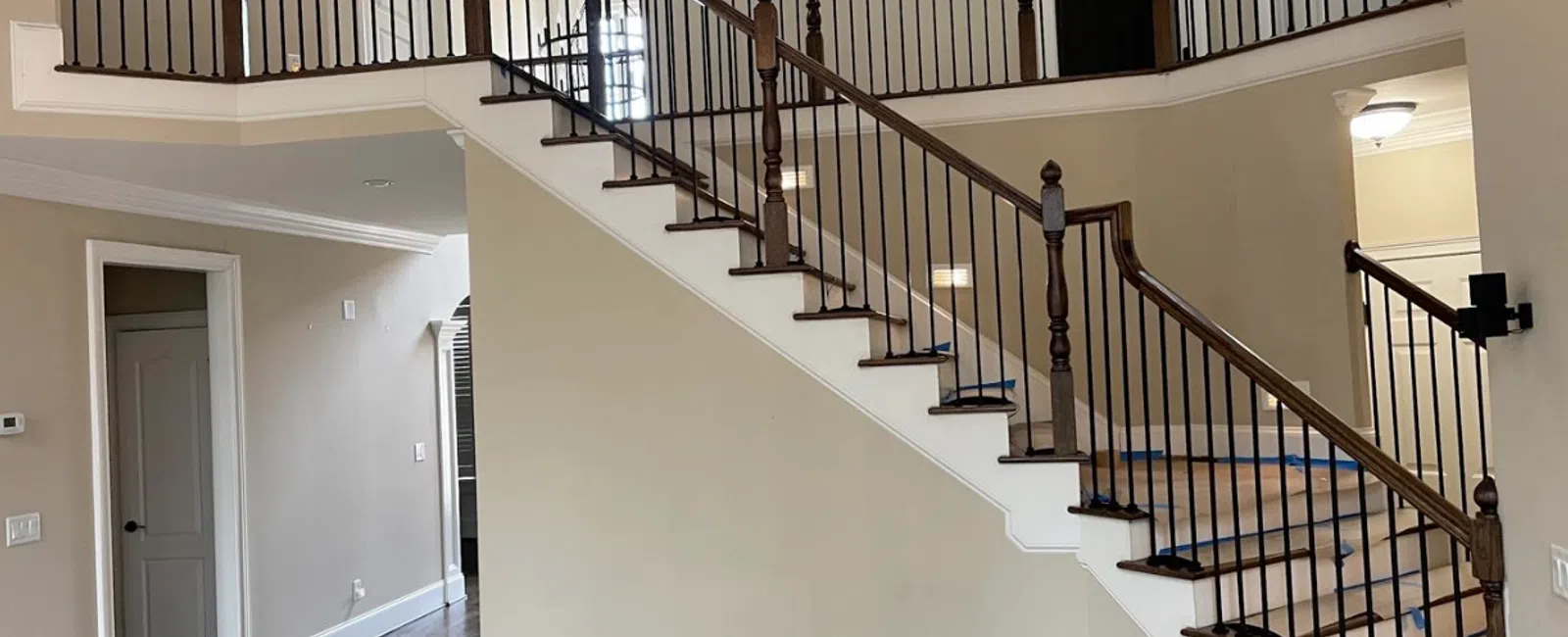
For most staircases, the best carpet is nylon in a tight loop or low-profile cut pile, installed over a firm 8-pound rebond pad. In households with dogs, triexta in a low cut pile or a patterned cut-and-loop is the better specification, because loops and claws are a poor combination. Polyester is the fiber to avoid on stairs regardless of household, even though it is the one most homeowners are drawn to.
That is what we install on the majority of the staircases we do. The reasoning behind it comes down to a single mechanical fact, which is that carpet on a staircase fails at the nose of the tread first.
What We Recommend By Household
| Household | Fiber | Construction | Pad |
|---|---|---|---|
| Standard family home, no dogs | Nylon | Tight loop | 8-pound rebond |
| Dogs in the house | Triexta | Low cut pile or patterned cut-and-loop | 8-pound rebond with moisture barrier |
| Young children, frequent spills | Triexta | Patterned cut-and-loop | 8-pound rebond with moisture barrier |
| Low-traffic or formal staircase | Wool | Runner with custom binding | Firm, thin pad |
| Rental or investment property | Mid-grade nylon | Tight loop | 8-pound rebond |
The pattern across all of those rows is that stairs want a harder-wearing fiber and a shorter pile than the rest of the house, over a pad that is denser and thinner than what belongs in a bedroom.
Why Stairs Wear Carpet Faster Than Floors
On a flat floor, foot traffic spreads across a wide area, and the carpet backing sits flush against the pad beneath it. A staircase removes both of those conditions.
- Traffic concentrates into a band roughly the width of a shoe, in the same position on every tread, because people place their feet predictably going up and down. The carpet also has to wrap a hard ninety-degree edge, which leaves the pile at that edge under tension and splayed open rather than standing upright.
- The consequence is that tall, loose pile gets pushed flat at the nose and does not recover, which shows up as a darker worn stripe across the front of each step. A carpet that would still look new after a decade in a bedroom can develop that stripe within a couple of years on a staircase.
There is a safety element as well. Deep pile over a thick pad gives underfoot, and that softness makes each tread feel less stable, particularly on the way down.
Why Nylon Leads On Stairs
| Fiber | Performance on stairs | Verdict |
|---|---|---|
| Nylon | The most durable of the common residential fibers. It resists crushing and rebounds from compression better than the alternatives. | Best choice for most staircases |
| Triexta (SmartStrand) | Softer than nylon and more durable than polyester. Stain resistance is built into the fiber rather than applied on top, so it does not wear away. | Best choice with dogs or young children |
| Wool | A premium natural fiber that performs well in a runner, where the wood carries part of the load. Costs considerably more than any synthetic. | Worth it on a staircase that functions as a design feature |
| Polyester | The softest and most popular fiber overall, though it crushes under repeated traffic. | Avoid on stairs |
Polyester deserves the direct warning because it is what most homeowners gravitate toward in the showroom. It holds vivid color, resists staining naturally, and feels excellent underfoot. It also flattens at every tread nose, which means the bedroom carpet can look fine for years while the matching stair carpet gives out well ahead of it.
When the intention is to run one carpet from the staircase through the upper level, select for the stairs and let the bedrooms follow. A nylon or triexta chosen for stair durability will perform perfectly well in a bedroom. The reverse does not hold.
Pile Height And Construction
- Tight loop is the strongest construction on stairs. The loops are short, dense, and anchored at both ends, which leaves far less fiber able to splay open at the tread edge. Dogs are the one situation where we move away from it. A claw catches a loop and pulls a run, and stairs tend to be where dogs move fastest. In those homes, a low-profile cut pile or a patterned cut-and-loop gives most of the durability without the snagging risk.
- Patterned cut-and-loop is the option we reach for most often when a staircase sits in the middle of a two-story foyer, since the pattern hides wear well and gives the staircase some visual interest on its own.
- Deep plush and Saxony are better suited to formal rooms and master bedrooms. On a staircase, both will show wear at the nosing within the first two years.
One check applies to every product under consideration. Not all carpet is rated for stair installation, because manufacturers specify which of their products can wrap a nosing without the backing splitting or the pile distorting. That specification is worth confirming before any other conversation about a product begins.
Pad Density And Thickness On Stairs
Stairs qualify as high-traffic for pad purposes, which means 8-pound rebond density rather than the 6-pound minimum that covers ordinary residential rooms.
- Thickness runs opposite to the rest of the house. A thick pad prevents the carpet from wrapping tightly over the nosing and makes each tread feel soft and unstable underfoot. A firmer, thinner pad is the better choice on stairs even in a house where the bedrooms receive something plusher.
- Warranty coverage is the other reason the pad matters here. Most manufacturers specify a minimum pad density for their carpet, and installing below that specification can void the warranty entirely.
In homes with pets or young children, a moisture-barrier pad on the stairs is worth the modest upgrade, since stairs are difficult to clean thoroughly once something has soaked through to the subfloor.
Waterfall And Upholstered Installation
Waterfall installation carries the carpet straight off the front of each tread and down to the next step without wrapping the riser tightly. It requires less labor, costs less, and suits straight staircases with square nosings. This is the method most wall-to-wall stair jobs use.
Upholstered installation wraps the carpet tightly around the contour of each nosing and down the riser, following the shape of the staircase. It takes considerably more time per step and produces a better result on curved staircases and rounded nosings.
Runner, Wall-To-Wall, And Bare Treads
Wall-to-wall stair carpet is the quietest and softest of the three, and the most forgiving if someone misses a step. It is usually the right choice when the upstairs is already carpeted, and the goal is continuity across the entire upper level.
A stair runner leaves wood exposed on both sides and produces more visual change per dollar than nearly any other flooring project. Runners also work well in homes with dogs, since the runner gives claws something to grip while protecting the wood underneath from scratching. Custom binding along the edges, in cotton or leather, is what gives a runner a finished, built-in appearance.
Bare hardwood treads match a main level cleanly and contribute the most at resale, though they are louder and harder underfoot. It is worth considering how the upper level is finished before committing, because hardwood stairs leading up to carpeted bedrooms can read as unfinished at the landing.
Seeing Samples On Your Own Staircase
Stair carpet is difficult to evaluate from a sample board under showroom lighting. What matters is how the pile behaves once it bends over a nosing, and a flat swatch cannot demonstrate that. Laying a sample across three actual steps, in the light of your own foyer, makes the difference visible immediately.
That is why our stair carpet installation begins in your home rather than a showroom. A dedicated Project Manager selects stair-rated samples for your household and your existing flooring, lays them on the staircase you are replacing, and walks through carpet fiber and pad selection, installation method, and how the carpet will meet the flooring at the top and bottom of the run.
Stair work is priced per step rather than by square footage, so your estimate reflects the construction and step count of your staircase instead of an average. We deliver it in writing within 24 hours, and the finished work is covered by our lifetime installation warranty.
Schedule a free in-home consultation or call 770-587-3438, and we will bring stair-rated samples to your staircase.